

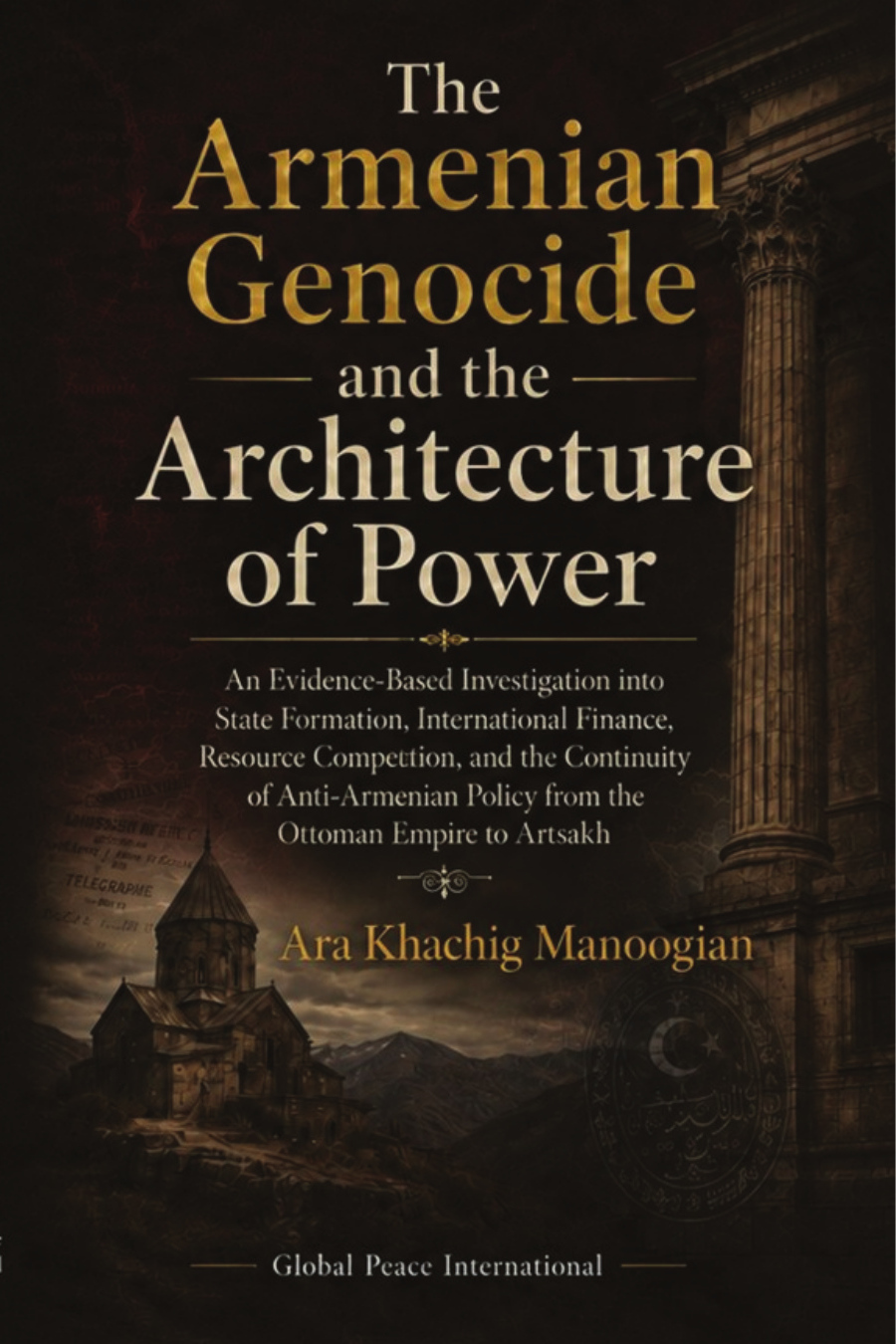
An Evidence-Based Investigation into State Formation, International Finance, Resource Competition, and the Continuity of Anti-Armenian Policy from the Ottoman Empire to Artsakh
Secure checkout is completed through Books.by, our trusted fulfillment & payment partner.
The Armenian Genocide did not occur in isolation. It unfolded within a larger architecture of political power, international finance, military assistance, commercial ambition, and geopolitical calculation.
In The Armenian Genocide and the Architecture of Power, investigative journalist Ara Khachig Manoogian moves beyond the familiar question of who carried out the genocide to examine a broader and more difficult one: Who benefited from the destruction and displacement of the Armenian people, and how were those consequences preserved?
Drawing upon archival correspondence, diplomatic dispatches, military records, treaties, corporate papers, legal materials, and modern scholarship, Manoogian investigates the intersection of Ottoman policy with imperial rivalry, arms transfers, banking, transportation networks, commercial concessions, resource competition, and the international settlement that followed the First World War.
The book traces the Armenian Question from the late Ottoman period through the Hamidian and Adana massacres, the rise of the Committee of Union and Progress, the deportations and mass killings of 1915, the collapse of the Ottoman Empire, the financing of the Turkish National Movement, the abandonment of the Treaty of Sèvres, and the political order established at Lausanne. It then follows recurring patterns of dispossession, demographic engineering, diplomatic accommodation, and international inaction into the modern struggle over Artsakh.
Rejecting both denial and unsupported conspiracy theories, Manoogian applies a disciplined evidentiary method that distinguishes documented fact, historical inference, contested interpretation, and speculation. Responsibility is assigned only where the documentary record supports it.
This is not merely another history of the Armenian Genocide. It is an investigation into the systems that surrounded the crime, the institutions that shaped its aftermath, and the enduring structures that allowed its territorial, economic, and political consequences to survive.
A comprehensive work of history, documentation, and accountability for readers seeking to understand not only how the Armenian people were destroyed, but how the resulting architecture of power was built and sustained.
Order Now on Books.by